Louis Vuitton Brand Strategy: How Heritage and Collaboration Built a $20B Brand
Louis Vuitton operates at the intersection of heritage preservation and cultural disruption, a balance that eludes most luxury brands. Founded in 1854 as a trunk maker, the house built its reputation on craftsmanship and innovation, yet maintains relevance in 2025 through artistic collaborations with streetwear labels, contemporary artists, and cultural icons that would have seemed impossible for traditional luxury houses a generation ago.
That ability to honor 170 years of history while partnering with Supreme, Takashi Murakami, and Pharrell Williams demonstrates strategic flexibility that competitors struggle to replicate. And it offers lessons for any clothing brand navigating the tension between heritage and relevance.
This case study breaks down the Louis Vuitton brand strategy, its collaboration model, and what smaller brands can take from it directly.
What You Can Learn From Louis Vuitton
Four principles run through everything Louis Vuitton has built. Keep these in mind as you read the full breakdown.
- Heritage is a creative framework, not a constraint. The LV monogram has been reimagined by Murakami, Supreme, and Virgil Abloh. The codes stayed constant. The expression changed.
- Collaboration works when it’s filtered through brand identity. Louis Vuitton selects partners whose aesthetic complements its codes rather than contradicting them. Innovation reinforces rather than dilutes.
- Distribution control is pricing control. No discounts, no outlet stores, no wholesale partners who can undercut you. Owning the retail relationship means owning the brand experience.
- Storytelling is as important as the product. The Asnières workshop, the 1854 founding, the trunk-making heritage: Louis Vuitton communicates these consistently because they justify the price premium as much as the leather does.
Louis Vuitton Timeline: 170 Years of Heritage and Innovation
The brand’s evolution spans over a century and a half of strategic decisions that transformed a trunk maker into the world’s most valuable luxury house.
- 1854 — Louis Vuitton opened his first workshop at 4 Rue Neuve-des-Capucines in Paris, creating flat-topped trunks that revolutionized luggage by allowing easy stacking during train travel.
- 1896 — Georges Vuitton introduced the iconic LV monogram canvas featuring interlocking initials, quatrefoils, and flowers on a chocolate brown background, initially designed to combat counterfeiting.
- 1987 — Louis Vuitton merged with Moët Hennessy to form LVMH, creating the world’s largest luxury conglomerate while maintaining brand independence.
- 1997 — Marc Jacobs became the first creative director, launching ready-to-wear collections and initiating the brand’s transformation from luggage specialist into complete fashion house.
- 2001 — The Stephen Sprouse collaboration overlaid fluorescent graffiti on the monogram canvas, proving Louis Vuitton’s customer base valued cultural disruption over traditional luxury conservatism.
- 2003 — The Takashi Murakami collaboration introduced the Multicolor Monogram, reimagining heritage codes through contemporary art and opening Louis Vuitton to younger customers and Asian markets.
- 2017 — The Supreme collaboration brought luxury and streetwear together in one of the most culturally significant fashion partnerships of the decade, selling out globally within hours.
- 2018 — Virgil Abloh was appointed menswear artistic director, bringing streetwear credibility and cultural connectivity that traditional luxury creative directors couldn’t provide.
- 2023 — Pharrell Williams was named men’s creative director, continuing Louis Vuitton’s strategy of appointing unexpected cultural figures with genuine cross-industry credibility.
Louis Vuitton’s Heritage and Craftsmanship Strategy
Louis Vuitton’s product strategy demonstrates how manufacturing excellence becomes brand differentiation when communicated consistently across generations.
Solving Practical Problems With Innovation
The brand built its reputation by solving a genuine problem for wealthy travelers. Louis Vuitton’s flat-topped trunk, introduced in 1858, addressed a real need as rail travel expanded across Europe. Traditional rounded-top trunks couldn’t be stacked efficiently in train compartments. That functional improvement, combined with lightweight canvas construction and waterproof coating, created competitive advantage based on performance rather than aesthetics alone.
That origin matters because it grounds the brand’s heritage in utility, not luxury for its own sake. Louis Vuitton solved a problem first and became a status symbol second. That sequence gives the heritage credibility that brands reverse-engineering prestige cannot manufacture.
Building Heritage Through Consistent Storytelling
The Asnières workshop, opened in 1859 just northeast of Paris, still operates today with craftsmen creating leather goods and special orders. That continuity allows Louis Vuitton to claim heritage authenticity that newer luxury brands cannot match. The workshop serves a dual purpose: actual production facility and narrative asset that reinforces the brand story.
Heritage storytelling evolved from practical benefits to cultural signaling, yet retained manufacturing credibility throughout. That continuity between origin story and current product is what separates genuine heritage from manufactured nostalgia.
Creating Recognizable Brand Signatures
The monogram canvas, developed by Georges Vuitton in 1896, transformed a counterfeiting defense into a cultural icon. The LV monogram appears on products across categories, from $300 accessories to $50,000 trunks, creating visual consistency that reinforces brand identity regardless of price point. Damier canvas, introduced in 1888, offered similar recognition through its distinctive checkered pattern.
These signatures work because they originated from function and necessity, not marketing. That authenticity is what allows them to survive collaboration after collaboration without feeling diluted.
Louis Vuitton Collaborations: From Murakami to Supreme
Louis Vuitton pioneered luxury-art partnerships that transformed fashion marketing while creating products with genuine cultural resonance beyond commercial intent.
Marc Jacobs Breaks Traditional Boundaries
Before Marc Jacobs, luxury houses rarely partnered with living artists or contemporary designers. The industry maintained clear hierarchies: fashion remained separate from fine art, luxury from streetwear culture. Jacobs dismantled these boundaries through partnerships that brought contemporary relevance to Louis Vuitton’s heritage codes.
The Stephen Sprouse collaboration in 2001 demonstrated how graffiti could elevate luxury when executed with brand discipline. Sprouse’s fluorescent graffiti overlaid on the monogram canvas shocked luxury purists. The collection sold out immediately, proving the customer base valued cultural disruption over traditional luxury conservatism.
Artist Partnerships Create Cultural Currency
The Takashi Murakami partnership from 2003 became Louis Vuitton’s most commercially successful collaboration. The Multicolor Monogram reimagined the LV pattern in 33 colors on white or black backgrounds. Murakami’s cherry blossom designs and cartoon characters introduced playful elements to a brand known for serious luxury, lasting over a decade and generating hundreds of millions in revenue.
These collaborations worked because they maintained brand control while granting artists genuine creative authority. Louis Vuitton selected partners whose aesthetic complemented its brand codes rather than contradicting them, ensuring innovation reinforced rather than diluted brand positioning.
The Supreme Partnership Validates Street Culture
The Supreme partnership in 2017 was the boldest cultural move. Supreme built its brand on exclusivity, limited drops, and subcultural credibility that rejected mainstream luxury. Rather than damaging both brands, the collaboration validated their cultural authority. The collection sold out globally within hours, with resale prices reaching 5-10x retail value.
What separated this from a licensing deal was production quality. Louis Vuitton manufactured the collaborative products to the same standards as its mainline collections, preventing the collaboration from feeling like a cash grab on either side.
Creative Directors From Unexpected Backgrounds
The collaboration strategy extended beyond product to creative direction. Hiring Virgil Abloh as menswear artistic director in 2018 brought streetwear credibility that traditional luxury creative directors couldn’t provide. His tragic death in 2021 demonstrated both the power and the risk of building brand strategy around individual creative talent.
The Pharrell Williams appointment in 2023 continued the pattern: an unexpected creative director with genuine cultural credentials across music, fashion, and luxury. His background spanning Adidas and Chanel demonstrated cultural fluency that money alone cannot manufacture.
Louis Vuitton’s Marketing Strategy and Distribution Control
Louis Vuitton’s marketing approach demonstrates how controlled scarcity and selective distribution create luxury positioning that mass availability destroys.
No Discount Policy Builds Long-Term Value
Louis Vuitton products never appear in sale seasons, outlet stores, or discount channels. That discipline requires conviction to absorb short-term opportunity costs, yet builds brand equity that justifies premium pricing indefinitely. The no-discount rule trains customers to buy at full price or not at all, which maintains perceived value across the entire product range.
Owned Retail Creates Controlled Experiences
Louis Vuitton operates over 460 stores globally, primarily company-owned boutiques that allow complete control over presentation, staffing, and customer experience. That vertical integration costs significantly more than traditional wholesale distribution, yet delivers a consistent brand experience that reinforces luxury positioning at every touchpoint.
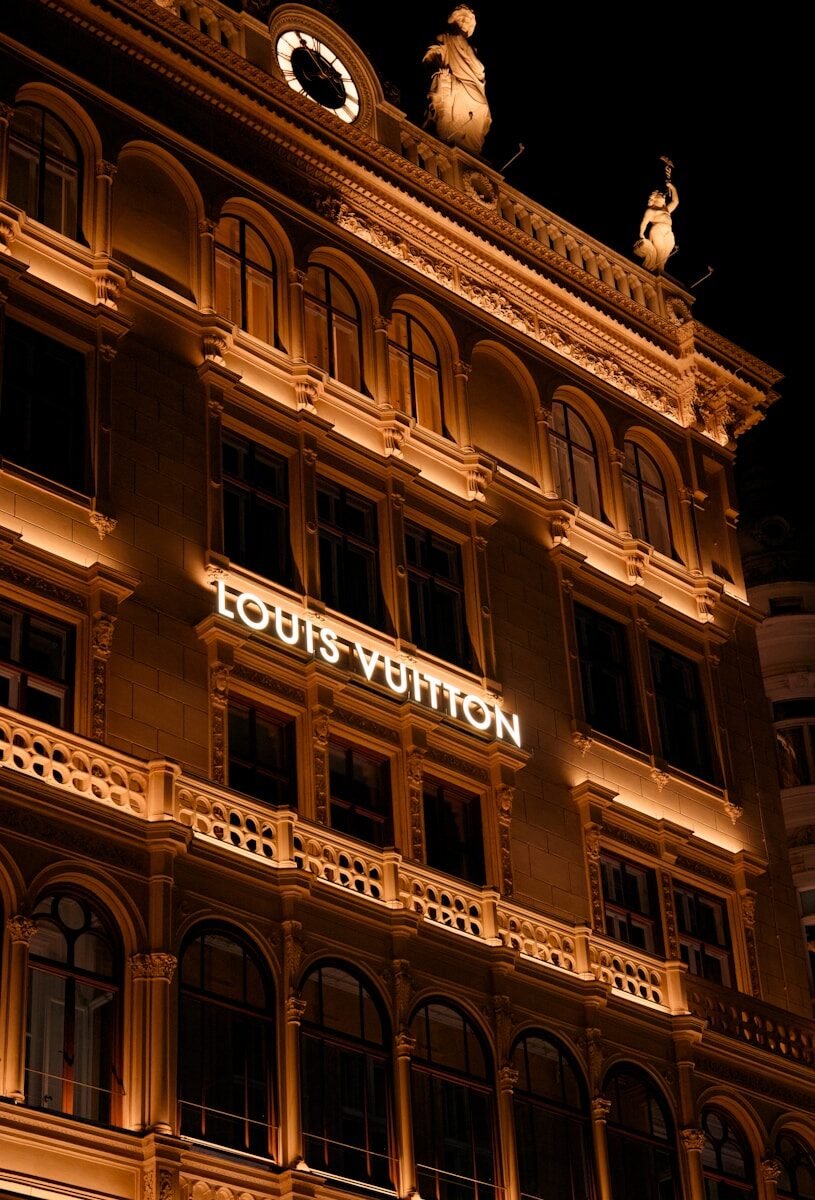
Flagship stores in Paris, London, and New York function as brand marketing rather than purely retail operations. These locations create experiential retail that justifies premium pricing through immersive environments, positioning Louis Vuitton alongside cultural institutions rather than commercial retailers.
Digital Strategy Balances Access With Exclusivity
Louis Vuitton sells products through its e-commerce platform but maintains careful curation of what appears online versus in physical stores. The brand invested heavily in virtual fashion shows and online campaigns during COVID-19 lockdowns, demonstrating that luxury brands can embrace technology without sacrificing exclusivity when the execution matches the brand standard.
LVMH Ownership: Corporate Structure Behind Louis Vuitton
Louis Vuitton’s position within LVMH provides resources and strategic advantages while maintaining the operational independence that allows bold creative decisions.
Corporate Resources Enable Long-Term Thinking
The 1987 merger that created LVMH brought together Louis Vuitton’s fashion expertise with Moët Hennessy’s wine and spirits business. Bernard Arnault gained control of LVMH in 1989, beginning his transformation of the conglomerate into the world’s largest luxury group. Louis Vuitton became LVMH’s flagship brand, generating approximately 40% of group revenue.
Corporate structure provides access to resources unavailable to independent luxury brands: purchasing power with media companies, landlords, and suppliers that smaller competitors cannot match. Louis Vuitton leverages LVMH’s infrastructure while maintaining creative autonomy in product development.
Strategic Portfolio Positioning Within LVMH
Louis Vuitton competes with LVMH stablemates like Dior, Fendi, and Celine for customer attention. The group manages this through careful positioning: Louis Vuitton emphasizes heritage and craftsmanship, Dior focuses on femininity and French elegance, Fendi leverages Italian luxury expertise. Each brand occupies distinct territory within the same conglomerate, preventing direct cannibalization while benefiting from shared resources.
What Clothing Brands Can Learn From Louis Vuitton
170 years of Louis Vuitton offers concrete lessons applicable at any scale. Here’s what translates directly.
Heritage Is a Creative Framework, Not a Museum Piece
Louis Vuitton demonstrates that brand longevity requires filtering innovation through established codes rather than preserving them unchanged. The monogram survived Murakami, Supreme, and Virgil Abloh because the brand treated it as a creative tool rather than a sacred object. For smaller brands: identify 2-3 non-negotiable brand elements and ensure every new product or collaboration reinforces those codes rather than replacing them.
Collaboration Works When It’s Selective and Disciplined
Louis Vuitton’s collaboration success came from choosing partners based on aesthetic alignment and cultural credibility, not commercial opportunity alone. Every collaboration was filtered through the brand’s visual language and produced to mainline quality standards. For smaller brands: approach collaborations as brand statements rather than revenue opportunities. One well-chosen partner amplifies credibility. A string of misaligned partnerships dilutes it.
Control Distribution to Protect Brand Value
Louis Vuitton proves that selective distribution builds more sustainable value than maximum availability. No discounts, no outlet stores, no wholesale partners who can undermine pricing. For smaller brands: resist wholesale partnerships that demand heavy margins unless the retailer adds genuine brand value. Use pre-order models or limited production runs to maintain pricing integrity without requiring boutique infrastructure.
Storytelling Is as Important as the Product
Louis Vuitton consistently communicates the Asnières workshop, the 1854 founding, and the trunk-making heritage because these stories justify the price premium as much as the leather quality does. For smaller brands: identify and consistently communicate your founding story through packaging, hangtags, and social content. Customers buying premium products want to know what they are buying into, not just what they are buying.
The Louis Vuitton Blueprint in One Sentence
Louis Vuitton won by treating its heritage as a living creative resource rather than a legacy to protect, which is the only reason it could partner with Supreme and still feel like Louis Vuitton.
If you want to apply the same thinking to your own brand, start here: how to start a clothing brand and marketing for clothing brands.
Frequently Asked Questions About Louis Vuitton
Louis Vuitton opened his first workshop in 1854 at 4 Rue Neuve-des-Capucines in Paris, initially creating flat-topped trunks for wealthy travelers. The brand expanded from luggage specialist to complete fashion house in 1997 when Marc Jacobs launched ready-to-wear collections. Today Louis Vuitton operates as LVMH’s flagship brand, generating over $20 billion in annual revenue.
Louis Vuitton is owned by LVMH, the world’s largest luxury conglomerate controlled by Bernard Arnault and his family. The 1987 merger between Louis Vuitton and Moët Hennessy created LVMH, which Arnault gained control of in 1989. Louis Vuitton generates approximately 40% of LVMH’s total revenue, making it the group’s most valuable brand.
Louis Vuitton treats its heritage codes, the LV monogram, the Damier canvas, the trunk-making origin, as a creative framework rather than a constraint. Each creative director reimagines those codes through a contemporary lens without replacing them. Collaborations with Takashi Murakami, Supreme, Virgil Abloh, and Pharrell Williams introduced new cultural perspectives while the underlying brand language remained constant. Heritage informs every decision without dictating it.
Louis Vuitton maintains a strict no-discount policy across all channels to protect long-term brand equity. Discounting trains customers to wait for lower prices, which erodes perceived value and weakens premium positioning. By refusing sales, outlet stores, and discount channels, Louis Vuitton ensures its products retain their full value over time, which also supports the resale market and reinforces the perception of Louis Vuitton as an investment rather than a purchase.
The Supreme collaboration worked because both brands approached it as a genuine cultural statement rather than a commercial exercise. Louis Vuitton manufactured the collaborative products to its mainline quality standards, preventing it from feeling like a licensing deal. Supreme’s street credibility and Louis Vuitton’s luxury heritage amplified each other rather than cancelling each other out. The collection sold out globally within hours and traded at 5-10x retail on the resale market, reflecting genuine demand from both brands’ communities.
Clothing brands can learn four things from Louis Vuitton: treat heritage as a creative framework rather than a museum piece; approach collaborations selectively and filter every partner through your brand’s core identity; control distribution to protect pricing integrity rather than maximizing short-term availability; and invest in storytelling as seriously as you invest in product, because the story is part of what customers are paying for.