
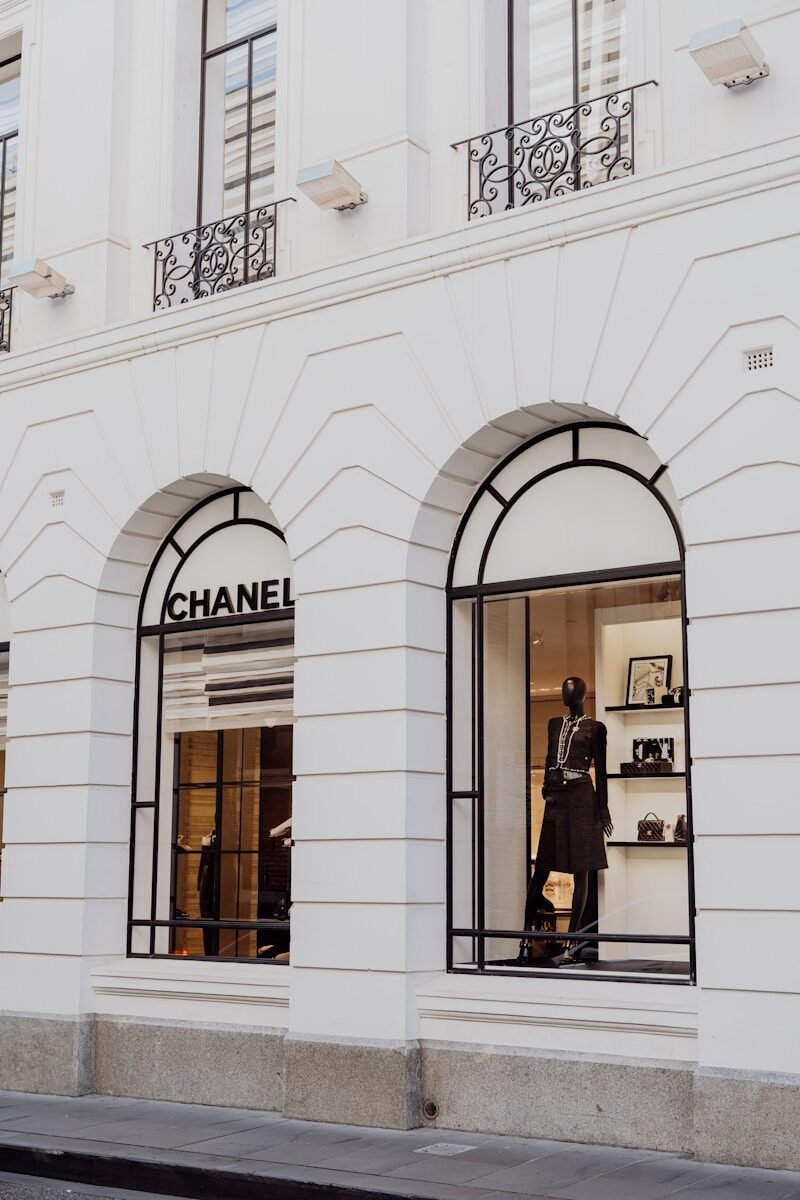
Chanel Brand Strategy: How a Century-Old House Stays Relevant
Chanel operates through a paradox most luxury brands can’t sustain: radical innovation that never abandons core identity. The house built its reputation on Coco Chanel’s revolutionary 1920s designs that freed women from corsets and ornamental excess, yet maintains that liberating spirit nearly a century later without feeling dated or nostalgic.
That balance, constant evolution rooted in unchanging principles, is exactly what made this French clothing brand one of fashion’s most commercially successful and culturally influential houses. And it offers lessons for any clothing brand trying to build something that lasts.
This case study breaks down Chanel’s brand strategy, scarcity model, visual identity system, and what smaller brands can take from it directly.
What You Can Learn From Chanel
Four principles run through everything Chanel does. Keep these in mind as you read the full breakdown.
- Private ownership enables long-term thinking. The Wertheimer family has owned Chanel for four generations. That independence allowed decisions based on brand integrity rather than quarterly earnings.
- Scarcity builds more value than availability. Chanel refuses to sell fashion online, avoids discount channels, and maintains waiting lists for iconic pieces. Restriction fuels desire.
- Brand codes create consistency across time. The interlocking C, quilted leather, tweed, and camellia aren’t decorative choices. They’re a system that lets creativity evolve without losing identity.
- Heritage is an active resource, not a museum artifact. Chanel references Coco’s legacy constantly but interprets it through a contemporary lens. Heritage informs rather than constrains.
Chanel Timeline: 115 Years of Luxury Innovation
The brand’s evolution spans over a century of strategic decisions that transformed luxury fashion and established enduring brand codes.
- 1910 — Coco Chanel opened her first boutique at 21 Rue Cambon in Paris, initially selling hats before expanding into jersey sportswear that challenged the corseted silhouettes dominating women’s fashion.
- 1921 — Chanel No. 5 launched, becoming the first designer fragrance and establishing the brand’s expansion beyond fashion into beauty.
- 1924 — Pierre Wertheimer partnered with Coco Chanel to commercialize Chanel No. 5, establishing the family ownership structure that continues to this day.
- 1954 — Coco Chanel returned from self-imposed exile at age 71, staging a comeback with updated versions of her classic designs that re-established brand relevance.
- 1971 — Coco Chanel died at age 87 while still actively designing, leaving the house without clear creative direction.
- 1983 — Karl Lagerfeld was appointed creative director, initiating a 36-year tenure that transformed Chanel from heritage brand into contemporary luxury powerhouse.
- 2019 — Karl Lagerfeld died at age 85, with Virginie Viard succeeding him as creative director.
- 2024 — Matthieu Blazy was appointed creative director, bringing his product-focused design philosophy from Bottega Veneta to continue Chanel’s evolution.
Chanel’s Private Ownership and Long-Term Brand Strategy
Chanel’s ownership structure fundamentally shapes every strategic decision and distinguishes it from publicly traded luxury conglomerates.
Family Control Across Four Generations
Brothers Alain and Gérard Wertheimer own Chanel entirely through holding company Chanel Limited, inheriting control from their grandfather Pierre Wertheimer who partnered with Coco Chanel in 1924. That family ownership, maintained across four generations, allows decision-making focused on brand strength rather than stock price or quarterly earnings.
The Wertheimers maintain extreme privacy, avoid media appearances, and run Chanel with minimal public communication. That discretion contrasts sharply with Bernard Arnault of LVMH or François-Henri Pinault of Kering, whose public profiles and acquisition strategies dominate fashion business coverage. Different priorities: building enduring brand equity rather than expanding portfolio breadth.
Patient Capital Enables Creative Consistency
Private ownership proved strategically crucial at multiple inflection points. When Karl Lagerfeld transformed Chanel from 1983 onward, the Wertheimers supported his vision through years of investment before commercial payoff materialized. A public company facing shareholder pressure might have demanded faster returns or replaced leadership after initial resistance from critics.
The numbers reflect this long-term thinking. Chanel’s own 2024 financial results show $18.7 billion in revenue, down 4.3% from 2023’s peak, with operating profit falling 30% amid a luxury market slowdown. Despite those declines, Chanel increased capital expenditure 43% to a record $1.8 billion, funding boutique expansion, manufacturing acquisitions, and creative investment. That countercyclical spending is impossible for public companies whose stock price punishes revenue declines and profit compression simultaneously.
Independence From Luxury Conglomerates
While LVMH acquired Dior, Fendi, and Givenchy, and Kering assembled Gucci, Saint Laurent, and Bottega Veneta, Chanel remained independent. That autonomy preserves brand focus impossible within conglomerates managing dozens of labels competing for resources.
Independence also enables decisions that prioritize brand equity over efficiency. Chanel owns specialized craft ateliers including Lesage embroidery, Lemarié featherwork, and Massaro shoemaking, acquired not for financial returns but to preserve endangered skills and ensure access to the highest level of craftsmanship. A conglomerate might consolidate or outsource these capabilities entirely. Chanel’s vertical integration costs more but creates a quality moat that money alone can’t replicate.
Chanel’s Scarcity Marketing and Pricing Power
Chanel builds brand value through controlled scarcity that contradicts conventional retail wisdom about maximizing availability and sales volume.
Boutique-Only Distribution Creates Exclusivity
Chanel refuses to sell fashion and leather goods online, restricting purchases to physical boutiques where brand experience and scarcity can be controlled. Beauty and fragrance appear in department stores and online, but core fashion remains boutique-exclusive.
The brand also refuses participation in sale seasons, discount channels, or outlet stores. That discipline creates a perception of scarcity that drives desire even when production capacity could accommodate higher volume. Waiting lists for the Classic Flap Bag, reportedly extending 2-3 years for popular colors, demonstrate how restriction fuels demand rather than satisfying it.
Aggressive Price Escalation Tests Demand Elasticity
Chanel implemented aggressive pricing escalation from 2020-2024, with the Classic Medium Flap Bag rising from approximately $6,500 in 2020 to $11,300 in 2025. Regular price increases serve multiple strategic purposes:
- They create urgency among potential buyers who purchase sooner rather than face higher future prices
- Rising retail prices boost resale market value, strengthening the brand’s investment narrative
- Price positioning signals exclusivity, aligning Chanel with Hermès rather than more accessible luxury brands
CFO Philippe Blondiaux stated the company would moderate price increase frequency in 2024-2025, suggesting recognition that elasticity limits exist even for ultra-luxury goods.
Controlled Availability Fuels Secondary Markets
Classic Flap Bags in discontinued colors or limited editions trade on resale platforms at premiums above retail. That secondary market activity, while generating zero revenue for Chanel, reinforces the perception of products as investments rather than depreciating consumer goods.
Chanel produces sufficient volume to meet demand but restricts access through boutique-only sales, strategic timing, and controlled regional allocation. Scarcity stems from distribution policy rather than production constraints, allowing flexibility to adjust volume without contradicting the scarcity positioning.
Karl Lagerfeld’s Creative Direction: 36-Year Legacy
Karl Lagerfeld’s appointment as creative director represents the most consequential leadership decision in modern Chanel history, demonstrating how sustained vision builds lasting brand equity.
Reviving a Creatively Dormant Heritage Brand
When Lagerfeld arrived in 1983, Chanel had stagnated following Coco’s 1971 death. Commercially viable but creatively dormant. He inherited codes, heritage, and craftsmanship infrastructure but needed contemporary vision to make those assets relevant to new generations.
His approach balanced reverence for Chanel codes with irreverent modernization. He retained core elements like quilted leather, chain straps, tweed, camellias, and the interlocking C, but recontextualized them through contemporary silhouettes and unexpected materials. Early collections faced criticism from the French press but proved enthusiastic reception in America, demonstrating Lagerfeld’s understanding that heritage must be activated through a current cultural lens rather than preserved unchanged.
Theatrical Runway Shows as Marketing Innovation
Lagerfeld revolutionized fashion presentation through runway shows that transcended traditional catwalk formats. Chanel shows at Grand Palais featured full-scale recreations of airports, supermarkets, rocket launches, beaches, and forests. These spectacles generated massive media coverage while demonstrating creative ambition without constraint.
The Métiers d’Art shows, launched in 2003, spotlighted Chanel’s ownership of specialized craft ateliers for embroidery, featherwork, and pleating, positioning the brand as patron of endangered artisanal skills. These brand moments created content that dominated fashion media cycles and social platforms, generating awareness worth far more than advertising costs.
Product Innovation Within Heritage Framework
Lagerfeld introduced the Classic Flap bag in 1983, evolving Coco’s 1955 original with the interlocking CC turnlock closure that became an instantly recognizable symbol. He expanded Chanel into watches with the J12 ceramic line in 2000, establishing credibility in horology that few fashion houses achieve.
His estimated 14 collections annually maintained constant newness while preserving the codes that ensure instant Chanel recognition. His tenure proved that creative directors can serve brands for decades when vision aligns with brand identity and ownership supports long-term thinking.
Chanel’s Brand Codes and Visual Identity System
Chanel’s visual identity system demonstrates how consistent design language builds recognition and equity across products, time periods, and creative directors.
Functional Origins of Iconic Design Elements
The interlocking C monogram, quilted diamond pattern, chain-leather straps, camellia flower, tweed fabric, and black-white-beige color palette function as codes that signal Chanel authenticity regardless of collection. That vocabulary, established by Coco and amplified by Lagerfeld, creates coherence that allows creative exploration without losing brand identity.
These codes originated from Coco Chanel’s design philosophy and personal aesthetics, not arbitrary decorative choices:
- Quilted leather referenced equestrian jacket padding, combining function with luxury
- Chain straps freed women from carrying handbags, inspired by caretakers’ key chains from her orphanage upbringing
- Camellias honored the flower she wore as a signature accessory
- Black challenged 1920s convention that treated the color as mourning rather than chic
These weren’t marketing inventions. They were solutions to real functional or cultural challenges, which gives them an authenticity that survives across decades.
Flexible Interpretation Maintains Contemporary Relevance
Lagerfeld understood that codes provide creative structure rather than limitation. He deployed core elements in unexpected contexts: tweed in sneakers, chains on leather goods beyond bags, camellias scaled to architectural proportion in runway sets. That flexible interpretation kept codes feeling fresh while maintaining instant recognition.
Successors Virginie Viard and current artistic director Matthieu Blazy inherit the same vocabulary, ensuring continuity even as individual creative vision evolves. The system proves that strong brand language enables rather than restricts creativity.
Vertical Integration Protects Craft Excellence
Chanel owns multiple Métiers d’Art houses including Lesage embroidery, Lemarié featherwork, Massaro shoemaking, and Desrues jewelry. These acquisitions protect specialized skills from market pressure while ensuring access to the highest level of craftsmanship. The vertical integration costs more than outsourcing but creates quality differentiation that justifies premium pricing and prevents competitors from accessing the same artisanal capacity.
Chanel’s Controversies and Contemporary Challenges
Chanel’s history includes controversies that complicate the brand narrative while demonstrating resilience through strategic adaptation.
World War II Collaboration and Historical Reckoning
Coco Chanel’s activities during World War II remain the most significant challenge to the brand’s narrative of female empowerment. She had a romantic relationship with Nazi intelligence officer Hans Günther von Dincklage and attempted to use Vichy antisemitic laws to seize Parfums Chanel from Jewish owners Pierre and Paul Wertheimer. The Wertheimers had transferred ownership to a Christian friend before fleeing to the United States, thwarting her attempt. After the war, Pierre Wertheimer negotiated a reconciliation that funded Coco’s 1950s comeback while the family regained full control.
The brand has largely avoided sustained damage through a combination of time passage, Wertheimer discretion, and a focus on Coco’s design legacy rather than personal biography. Recent scrutiny through books, documentaries, and the Apple TV series The New Look has had minimal impact on consumer purchasing patterns, suggesting either successful brand separation from founder or consumer willingness to prioritize product over history.
Sustainability Pressures and Digital Commerce Resistance
Contemporary challenges include sustainability pressure and digital commerce resistance. Chanel maintains its boutique-only policy for fashion despite the industry shift to omnichannel retail, risking sales loss to competitors offering online convenience. The strategy assumes luxury clients value exclusive boutique experience over transaction ease, but generational preferences may challenge that assumption.
The 2024 revenue decline of 4.3% and 30% profit drop demonstrate that even Chanel can’t fully insulate from luxury slowdown. Management responded with a hiring freeze while maintaining record investment spending, betting on long-term brand strength to weather short-term volatility.
What Clothing Brands Can Learn From Chanel
A century of Chanel offers concrete lessons applicable to brands at any scale. Here’s what translates directly.
Control Ownership Structure to Enable Long-Term Thinking
Private control allowed the Wertheimers to support Lagerfeld’s 36-year tenure, invest countercyclically during downturns, and refuse discount channels that would boost short-term sales while damaging long-term brand equity. Publicly traded competitors face quarterly earnings pressure that prevents that kind of patience.
For smaller brands: be deliberate about who you take investment from. Venture capital that demands rapid growth and exit often conflicts with the patient brand building that luxury positioning requires. Protect decision-making authority around brand identity, distribution strategy, and creative vision from financial pressure that prioritizes growth over equity.
Scarcity Builds More Value Than Maximum Availability
Chanel proves that controlled scarcity creates stronger brand equity than satisfying all demand. Limited distribution, no online sales, and waiting lists build desire that maximum availability can’t achieve. The strategy requires discipline to accept that some willing customers can’t access products immediately, sacrificing short-term revenue for long-term brand strength.
Smaller brands can apply this through limited edition releases, controlled retailer partnerships, and geographic exclusivity. Pre-orders, waitlists, and members-only access create similar dynamics at smaller scale. Supreme’s drop model shows how scarcity at scale builds billion-dollar brand value. The key is ensuring scarcity stems from intentional strategy rather than poor planning.
Establish Brand Codes Early and Deploy Them Consistently
Chanel’s visual vocabulary demonstrates how consistent design language allows creative exploration while maintaining instant brand recognition. The system enables evolution without identity loss, allowing new designers to contribute personal vision while honoring established DNA.
New brands benefit from establishing core design elements early. These codes shouldn’t be arbitrary aesthetics but should stem from brand philosophy, functional innovation, or cultural insight. Once established, deploy them across different contexts, materials, and scales. The discipline is filtering every decision through established brand language to ensure each collection reinforces rather than dilutes what makes the brand distinctive.
Treat Heritage as an Active Resource
Chanel references Coco’s designs, biography, and philosophy constantly but interprets them through a contemporary lens rather than preserving them unchanged. Heritage informs rather than constrains, keeping storytelling relevant rather than nostalgic.
Brands with founding stories, craft traditions, or cultural connections should communicate those narratives consistently while evolving their expression. Heritage creates differentiation in crowded markets where product quality alone can’t distinguish brands. The challenge is telling stories authentically rather than manufacturing false heritage. Brands like Patagonia show how purpose-driven heritage storytelling creates loyal communities.
Invest in Quality as a Competitive Moat
Chanel’s acquisition of Métiers d’Art houses demonstrates that product excellence creates defensible competitive advantage. Owning specialized craft capabilities prevents competitors from accessing the same quality while justifying premium pricing through tangible differentiation.
Smaller brands can’t acquire craft houses but can build quality reputation through material selection, construction methods, and manufacturing partnerships that prioritize excellence over cost minimization. Success requires authentic commitment to product rather than marketing claims, since quality reputation takes years to build but moments to destroy through inconsistent execution.
The Chanel Blueprint in One Sentence
Chanel won by making scarcity, heritage, and creative consistency work together as a single system rather than treating them as separate strategies.
The same principle scales down to any brand willing to build codes and stick to them. Founders working through how to start a clothing brand can apply Chanel’s discipline from day one, using the marketing for clothing brands fundamentals to build heritage instead of chasing every trend.
Frequently Asked Questions About Chanel
Chanel’s brand strategy is built on three pillars: controlled scarcity, consistent brand codes, and heritage activation. The brand refuses online sales for fashion, maintains boutique-only distribution, and uses waiting lists to build desire. Visual codes like the interlocking C, quilted leather, and tweed create instant recognition across collections and creative directors. Heritage is treated as an active resource rather than a museum artifact, interpreted through a contemporary lens with each new collection.
Chanel is privately owned by the Wertheimer family through holding company Chanel Limited. Brothers Alain and Gérard Wertheimer control the business, having inherited ownership from their grandfather Pierre Wertheimer who partnered with Coco Chanel in 1924. The company remains privately held, allowing long-term decision making focused on brand integrity rather than quarterly earnings.
Chanel maintains exclusivity through boutique-only distribution for fashion and leather goods, refusing to sell core products online or through discount channels. The brand implements regular price increases, maintains waiting lists for iconic pieces like the Classic Flap Bag, and controls regional product allocation. Scarcity stems from deliberate distribution policy rather than production limitations.
Chanel has stayed relevant by treating its founding codes as a creative framework rather than a constraint. Each creative director, from Karl Lagerfeld to Matthieu Blazy, reinterprets the same visual vocabulary through a contemporary lens. Private ownership has enabled consistent long-term investment in craftsmanship, retail, and creative direction without the pressure to chase short-term trends.
Chanel’s core brand values are elegance, craftsmanship, independence, and female empowerment. These trace directly back to Coco Chanel’s founding philosophy of freeing women from ornamental excess and designing for function as much as beauty. The brand maintains these values through product quality, vertical integration of craft ateliers, and a refusal to compromise distribution standards for short-term revenue.
Clothing brands can learn five things from Chanel: protect ownership structure to enable long-term thinking, use controlled scarcity to build desire rather than maximizing availability, establish brand codes early and deploy them consistently, treat heritage as an active storytelling resource, and invest in product quality as a long-term competitive moat rather than a cost to minimize.