
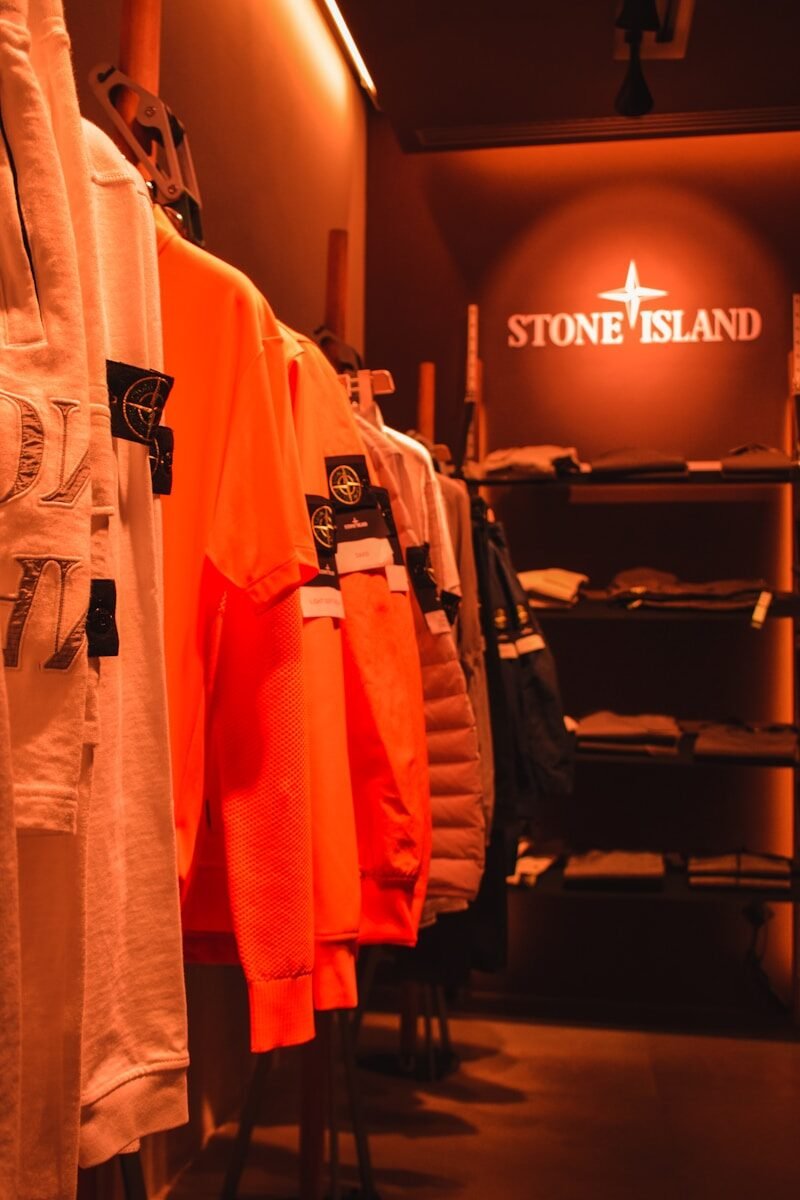
Stone Island Brand Strategy: How a Technical Fabric Brand Built a Cult Following
Stone Island is one of the most unusual success stories in fashion. A brand built around fabric research and functional outerwear, it found its way into places no marketing plan could have predicted. Italian football casuals wore it in the 1980s. Then UK rave culture adopted it in the 1990s. Hip-hop artists embraced it in the 2000s, and fashion editors and streetwear collectors picked it up worldwide after that. At no point did Stone Island court any of these audiences. Instead, they all came on their own terms.
Massimo Osti founded Stone Island in 1982 in Bologna, part of the Italian clothing brands scene. For over four decades the brand has done the same thing: develop technically advanced fabrics, apply them to functional outerwear, and attach a compass rose badge to the left sleeve. As a result, that badge has become one of the most recognizable symbols in fashion, worth more than most logos that cost ten times as much to build.
This case study breaks down how Stone Island built its cult following, and what smaller clothing brands can take from it directly.
What You Can Learn From Stone Island
Five principles run through everything Stone Island has built. Keep these in mind as you read the full breakdown.
- Product obsession is the most durable form of marketing. Stone Island has never run a traditional advertising campaign. Instead, the product generates its own advocacy because it is genuinely unlike anything else.
- Subcultures find authentic products without being invited. Football casuals, ravers, hip-hop artists, and fashion collectors all discovered Stone Island independently. In fact, the brand never targeted any of them.
- A single consistent brand code can do the work of an entire identity system. The compass rose badge on the left sleeve is all Stone Island needs. As a result, everything else follows from the product.
- Fabric innovation creates defensible competitive advantage. Competitors cannot simply copy Stone Island’s material research, because the knowledge and infrastructure needed to replicate it takes decades to build.
- Staying private protects creative integrity. For most of its history, Stone Island made decisions based on product and brand rather than quarterly earnings. As a result, that focus kept the brand’s identity coherent across four decades.
Stone Island Timeline: From Bologna Fabric Lab to Global Cult Brand
The brand’s evolution spans over four decades of material innovation and organic cultural adoption that no marketing campaign could have engineered.
- 1982 — Massimo Osti founded Stone Island in Bologna, Italy, as a laboratory for fabric experimentation. The first collection used a single fabric: a rip-stop material originally made for oil tanker sails. Osti dyed it in a washing machine to get a unique finish.
- 1983 — Stone Island introduced the compass rose badge on the left sleeve. Soon, it became the brand’s primary visual identifier and one of the most recognizable symbols in fashion.
- 1980s — Italian and British football casuals adopted Stone Island as a status symbol within terrace culture. The technical quality and the badge’s understated but recognizable signaling drew them in.
- 1993 — Massimo Osti sold his majority stake in Stone Island to the Rivetti family. They kept the brand’s commitment to fabric research and product integrity intact.
- 1990s — UK rave and club culture embraced Stone Island, with the brand becoming embedded in the aesthetic of Manchester, London, and Glasgow’s nightlife scenes.
- 2000s — Hip-hop artists including Drake and members of Skepta’s Boy Better Know collective started wearing Stone Island. As a result, that introduced the brand to a new global audience without any formal partnership or endorsement.
- 2010s — Streetwear and fashion communities worldwide discovered Stone Island. As a result, the brand grew significantly and became a collector’s item among enthusiasts who valued its technical heritage.
- 2020 — Moncler acquired Stone Island for approximately €1.15 billion. The deal brought corporate resources and global distribution infrastructure while keeping the brand’s operational independence and creative direction intact.
- 2024 — Stone Island continues to operate as an independent creative entity within the Moncler Group. It still releases seasonal fabric innovations and maintains the product-first approach that built its reputation.
Stone Island’s Fabric Innovation Strategy
Stone Island’s competitive advantage is rooted in something most fashion brands cannot replicate: genuine material research. That research produces products with performance characteristics unavailable anywhere else.
The Fabric Lab as Brand Foundation
Massimo Osti founded Stone Island as a fabric laboratory, not a fashion brand. The distinction matters. Most clothing brands start with a design aesthetic and source materials to execute it. Instead, Stone Island starts with a material and designs around what that material can do. As a result, that inversion produces garments that look and perform unlike anything conventional fashion processes create.
The first Stone Island jacket used a rip-stop cotton originally made for oil tanker sails. Osti discovered the material, understood its properties, and built a jacket around its capabilities. That approach, finding exceptional materials and designing to their strengths rather than forcing materials into predetermined designs, remains the brand’s creative methodology. In fact, it still guides every collection four decades later.
Garment Dyeing as Signature Process
One of Stone Island’s most distinctive techniques is garment dyeing. Instead of dyeing fabric before construction, the brand builds a complete jacket first and dyes the finished garment. This produces color variation and texture that flat fabric dyeing cannot achieve. As a result, each piece gets a depth and uniqueness that makes Stone Island garments visually distinctive even without the badge.
Because of this process, each piece also responds slightly differently, giving Stone Island products a handmade quality at industrial scale. That mix of technical sophistication and visual uniqueness drives collector behavior. Copying it, however, takes real investment in process knowledge and equipment.
Seasonal Fabric Experiments
Each Stone Island season introduces experimental fabrics built specifically for that collection. Past innovations include thermo-sensitive fabrics that change color with temperature and liquid crystal fabrics that shift appearance with movement. In addition, other fabrics develop a patina through exposure to sunlight and weather. These experiments are not gimmicks. Instead, they apply real material science to clothing design, producing functional and aesthetic properties unavailable elsewhere.
That seasonal innovation gives collectors and enthusiasts a reason to engage with each new release beyond trend-driven consumption. Buying Stone Island means buying access to a material experiment. That creates a fundamentally different relationship between brand and customer than conventional fashion purchasing. In fact, it is closer to the bond between a craftsman and a collector than between a brand and a consumer.
Stone Island’s Cult Following and Subculture Adoption
Stone Island’s cultural journey is one of the most studied examples of organic subculture adoption in fashion history. Notably, the brand did nothing to engineer it.
Football Casuals and the Badge as Signal
Stone Island’s first major subcultural adoption came through Italian and British football casual culture in the 1980s. In that world, casuals were working-class football supporters who competed through clothing rather than violence, wearing expensive and obscure European sportswear as a form of cultural one-upmanship. Stone Island’s technical quality made it a natural fit. So did the compass rose badge, recognizable to insiders but meaningless to outsiders.
The badge did something unusual: it signaled within a subculture without broadcasting itself to the mainstream. Wearing Stone Island meant something specific to people who understood it and nothing in particular to people who didn’t. In fact, that insider signaling is one of the most powerful mechanisms a brand can possess, and Stone Island achieved it without designing for it.
Rave Culture and Club Scene Adoption
In the late 1980s and 1990s, Stone Island migrated from football terraces to rave venues and club culture, particularly in the North of England. The same qualities that appealed to casuals, technical quality, functional design, understated status signaling, fit naturally with rave culture too. After all, that scene valued authenticity and subcultural knowledge over mainstream fashion credentials.
Manchester in particular took to Stone Island. As a result, the brand became embedded in the cultural mythology of a city that also produced the Haçienda, Oasis, and the Stone Roses. That geographic association gave Stone Island a layer of cultural meaning beyond the garments. Consequently, it tied the brand to a specific time and place in British cultural history, one that still resonates with multiple generations of music and fashion enthusiasts.
Hip-Hop Adoption and Global Reach
Artists including Drake, Skepta, and A$AP Rocky brought Stone Island into hip-hop culture during the 2000s and 2010s. As a result, that introduced the brand to a global audience with no connection to its football casual or rave culture origins. These artists wore Stone Island because it represented genuine quality and subcultural credibility, the same values that had driven adoption in every previous community.
Drake’s frequent public appearances in Stone Island generated millions of dollars worth of organic brand exposure without any formal endorsement arrangement. The brand never paid for that visibility. Instead, it earned it simply by making a product that people with genuine cultural credibility chose to wear on their own terms.
Stone Island’s Badge and Visual Identity
Stone Island’s visual identity is almost entirely built around a single element: the detachable compass rose badge on the left sleeve.
The Badge as the Entire Identity System
Most brands require extensive visual identity systems: logos, color palettes, typography, brand guidelines. Stone Island, however, runs almost entirely on the strength of a single badge. That badge communicates everything the brand stands for: technical excellence, subcultural heritage, understated status, and membership in a community of people who know what it means.
The badge is detachable, which is itself a design statement. Some wearers want the product without the signal. Others, in contrast, want the signal without necessarily displaying it. As a result, Stone Island built for both, a flexibility that reflects rare brand confidence: Stone Island does not need you to advertise it. The badge is available if you want it, removable if you don’t.
No Logo, No Advertising, No Noise
Stone Island does not run traditional advertising campaigns. The brand has no celebrity ambassadors, no sponsored athletes, and no global marketing infrastructure comparable to its competitors. Instead, the product and the community it generates are the entire marketing strategy.
That approach requires a product good enough to generate its own advocacy, something Stone Island has maintained for four decades. It also requires discipline. Resisting the temptation to amplify reach through paid channels would speed up growth, but it would also dilute the exclusivity and subcultural credibility that make the brand valuable. In that sense, the community is the marketing department, exactly as it is for Corteiz and Supreme.
Moncler Acquisition and Brand Independence
Moncler acquired Stone Island in 2020 for approximately €1.15 billion. The deal raised immediate questions about whether corporate ownership would compromise the brand’s creative independence and subcultural credibility.
Why the Acquisition Made Sense
Stone Island had reached a scale where independent operation was becoming increasingly difficult. Global distribution, retail infrastructure, and supply chain complexity required resources the Rivetti family ownership could not efficiently provide. Meanwhile, Moncler had already navigated the transition from niche to global itself, while keeping its own product integrity intact. As a result, it offered a credible model for how Stone Island could scale without losing its identity.
The €1.15 billion valuation reflected the genuine brand equity that four decades of product obsession and organic cultural adoption had built. In other words, that is what authentic brand building looks like when it compounds over time.
Maintaining Independence Within a Larger Structure
Stone Island continues to operate with significant creative independence within the Moncler Group. It has kept the fabric research methodology, the seasonal experimental collections, and the product-first approach that built its reputation. Meanwhile, Moncler’s resources have supported global retail expansion and distribution improvements without forcing the brand to compromise its creative direction.
The acquisition is a useful reminder that independence and integrity are not the same thing. Stone Island held onto its creative integrity under family ownership, and it has done the same under corporate ownership. That consistency exists because the brand’s values live in its product methodology, not just its ownership structure.
What Clothing Brands Can Learn From Stone Island
Four decades of Stone Island offers lessons that apply far beyond technical outerwear. Here’s what translates directly.
Product Obsession Is the Most Durable Marketing Strategy
Stone Island has never needed a marketing department because the product does the work. Every seasonal fabric experiment, every garment-dyed jacket, every detachable badge demonstrates the brand’s values more effectively than any campaign could. For smaller brands, this means investing in making the product genuinely exceptional before investing in marketing it. After all, a product that people talk about unprompted is worth more than any advertising budget.
Subcultures Will Find You If Your Product Is Real
Football casuals, ravers, hip-hop artists, and fashion collectors all discovered Stone Island independently because the product was genuine and the values were consistent. For smaller brands, that suggests identifying the community where your product solves a genuine problem, serving that community exceptionally well, and trusting that adjacent communities will find you over time. In fact, trying to engineer subcultural adoption usually backfires.
A Single Strong Brand Code Beats a Complex Identity System
The compass rose badge is all Stone Island needs. It is recognizable, meaningful to insiders, and connected to decades of product heritage. For smaller brands, that means investing in developing one or two brand codes that are genuinely yours and deploying them with complete consistency. In short, a single strong code embedded deeply beats an elaborate identity system applied inconsistently.
Material and Manufacturing Decisions Define Brand Identity
Stone Island’s identity is inseparable from its material research. The garment dyeing process, the seasonal fabric experiments, and the technical construction standards are not just product features. Instead, they are the brand story. For smaller brands, this matters directly: the materials you choose, the construction standards you maintain, and the manufacturing processes you invest in all say something about what your brand stands for. Therefore, treat every material and production decision as a brand decision.
Patience Is a Competitive Advantage
Stone Island’s cultural relevance took decades to build. The football casual adoption of the 1980s laid the foundation for rave culture in the 1990s. That, in turn, laid the foundation for hip-hop adoption in the 2000s, which then laid the foundation for the global fashion community’s embrace in the 2010s. Each wave built on the authenticity the previous one established. For smaller brands, that means brand equity compounds over time, but only if you stay consistent. Ultimately, the discipline to maintain product standards and brand integrity matters most when growth is slow, since that discipline creates the foundation for cultural moments when they eventually arrive.
The Stone Island Blueprint in One Sentence
Stone Island won by building a product so technically and culturally genuine that every subculture it touched adopted it on its own terms. That is the only kind of cultural credibility that lasts.
The same principle scales down to any brand willing to let the product do the convincing. Founders working through how to start a clothing brand can apply Stone Island’s patience from day one. The marketing for clothing brands fundamentals show how to build a product worth talking about before spending on ads.
Frequently Asked Questions About Stone Island
Stone Island was founded in 1982 by Massimo Osti in Bologna, Italy. Osti established the brand as a laboratory for fabric experimentation rather than a conventional fashion label, with the first collection built around a single rip-stop material originally developed for oil tanker sails. The compass rose badge was introduced in 1983 and has remained the brand’s primary visual identifier ever since.
Stone Island is owned by the Moncler Group, which acquired the brand in 2020 for approximately €1.15 billion. Prior to the acquisition, Stone Island was owned by the Rivetti family, who had purchased a majority stake from founder Massimo Osti in 1993. Stone Island continues to operate with significant creative independence within the Moncler Group, maintaining its fabric research methodology and product-first approach post-acquisition.
Stone Island’s popularity stems from four decades of genuine product innovation and organic subcultural adoption. The brand was never marketed to the communities that made it desirable. Football casuals, rave culture, hip-hop artists, and fashion collectors all discovered it independently because the technical quality and understated status signaling of the compass rose badge resonated with people who valued authenticity over mainstream fashion credentials. That organic adoption built a credibility that no marketing campaign could have manufactured.
The Stone Island badge is a detachable compass rose patch worn on the left sleeve of Stone Island garments. It was introduced in 1983 and has become one of the most recognizable symbols in fashion, particularly within subcultures that value insider knowledge and understated status signaling. The badge is deliberately detachable, reflecting the brand’s confidence that wearers should choose whether to display it rather than being required to advertise the brand.
Stone Island differentiates itself through genuine fabric research that produces materials and construction techniques unavailable elsewhere. The brand’s garment dyeing process, seasonal experimental fabrics, and technical construction standards create products with performance and aesthetic properties that competitors cannot simply copy. Where most outerwear brands source existing materials and design around them, Stone Island develops its own materials and designs around their specific capabilities, producing a fundamentally different category of product.
Clothing brands can learn five things from Stone Island: product obsession is the most durable marketing strategy because a genuinely exceptional product generates its own advocacy; subcultures will find authentic products without being invited if the product is real enough; a single strong brand code deployed consistently is more valuable than a complex identity system; material and manufacturing decisions are brand decisions that communicate values as effectively as any campaign; and patience is a competitive advantage because brand equity compounds over time only if you stay consistent through the periods when growth is slow.