12 Italian Clothing Brands You Should Know (2026)
Italian fashion runs on a paradox few other countries pull off. Florence gave the world its oldest luxury leather houses, Naples still hand-finishes suits the way it did in the 1960s, and a handful of small mountain and valley towns you have probably never heard of quietly supply the raw cashmere and denim behind half the industry’s biggest names. Milan gets the fashion week headlines, but the real story runs through Piedmont wool mills, Veneto denim factories, and a medieval Umbrian hamlet one designer rebuilt with his own profits.
Compared with France or Switzerland, Italy’s fashion identity leans harder on family-run manufacturing than on centralized design houses alone, and several of the names below are still run by the grandchildren or great-nephews of the people who founded them. The twelve brands featured here were chosen for range rather than just recognition, spanning leather craftsmanship, cashmere, denim, and technical sportswear from six different Italian regions.
Italian Clothing Brands Overview
Here’s a quick overview of the twelve Italian brands featured in this guide, from a century-old Florentine leather house to a Milanese label whose founders just left to run Moschino.
- Gucci – Florence leather house since 1921, built by a former Savoy Hotel porter.
- Missoni – Sumirago knitwear label since 1953, famous for its zigzag “fiammato” pattern.
- Loro Piana – Quarona wool and cashmere mill since 1924, now under LVMH.
- Diesel – Breganze denim label since 1978, built on deliberately distressed jeans.
- Kiton – Naples bespoke tailoring house since 1968, known for 25 to 50 hour hand-finished suits.
- Brunello Cucinelli – Solomeo cashmere house since 1978, built on “humanistic capitalism.”
- Replay – Asolo denim label since 1978, home of the cult 901 jean.
- Candiani Denim – Robecchetto con Induno mill since 1938, now a sustainable denim leader.
- Marni – Milan label since 1994, named after the founder’s sister-in-law.
- Stone Island – Ravarino technical outerwear label since 1982, acquired by Moncler in 2020.
- Golden Goose – Venice sneaker brand since 2000, built around deliberately distressed leather.
- Sunnei – Milan label since 2014, whose founders became Moschino’s creative directors in 2026.
Italian Clothing Brands
Gucci
Location: Florence, Italy
Founded: 1921
Price level: luxury
Product type: leather goods, ready-to-wear
Style: heritage, maximalist
Website: gucci.com
Instagram: @gucci
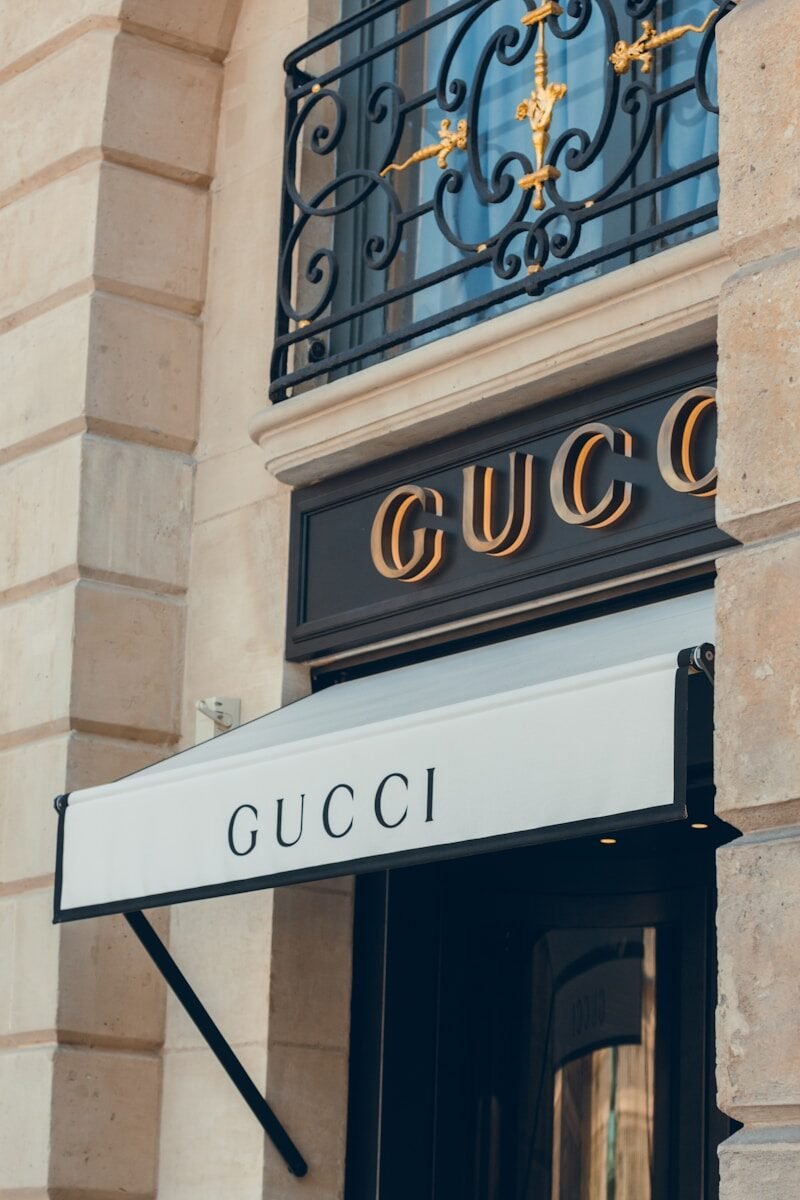
Guccio Gucci worked as a porter at London’s Savoy Hotel before returning to Florence, where he opened his own leather goods shop in 1921 after studying the trade at luggage maker Franzi. That early exposure to wealthy hotel guests and their travel cases directly shaped the brand, which Britannica notes started as a saddlery and luggage retailer before expanding into fashion under Gucci’s sons. The 1935 League of Nations embargo on Italy forced the house to substitute woven hemp for leather, accidentally producing the diamond-pattern canvas that became one of its signature materials. Guccio Gucci died in 1953, just fifteen days after the brand opened its first US store inside New York’s Savoy Plaza Hotel, a deliberate nod to where his career began. More than a century later, Gucci remains the clearest example of how a single founder’s personal history can define an entire house’s visual language.
Missoni
Location: Sumirago, Italy
Founded: 1953
Price level: luxury
Product type: knitwear, ready-to-wear
Style: colorful, geometric
Website: missoni.com
Instagram: @missoni
Ottavio Missoni met his future wife Rosita while competing in the 400m hurdles for Italy at the 1948 London Olympics, and the couple married and opened a small knitwear workshop in Gallarate five years later. Their real breakthrough came from a Raschel knitting machine, discovered on a trip to a shawl factory, which let them knit multiple colors into the zigzag pattern that became the brand’s signature. A 1967 show at Florence’s Pitti Palace turned controversial when the models’ sheer Lurex dresses proved translucent under the runway lights, a moment that accidentally built the brand’s international reputation. The company later moved its base to Sumirago, where the Missoni family still lives next door to the factory. Missoni remains one of the clearest examples of a genuine craft accident, the see-through fabric, becoming a defining commercial asset.
Loro Piana
Location: Quarona, Italy
Founded: 1924
Price level: luxury
Product type: fabric, ready-to-wear
Style: refined, understated
Website: loropiana.com
Instagram: @loropiana
The Loro Piana family had already been trading wool since the early 1800s when engineer Pietro Loro Piana founded the company’s current mill in Quarona in 1924, shifting the business from simply selling wool fabric to manufacturing it directly. His nephew Franco took over in 1941 and pushed the company into exporting premium wool and cashmere to Europe, the United States, and Japan during the postwar boom. Later generations sourced increasingly rare fibers, including vicuna from the Andes and baby cashmere from Mongolia, positioning the mill as a supplier to the world’s biggest luxury houses before it built its own retail brand. LVMH acquired roughly 80 percent of the company in 2013 for around two billion euros, while the Loro Piana family kept a minority stake. The mill still operates from the same Quarona headquarters Pietro built a century ago.
Diesel
Location: Breganze, Italy
Founded: 1978
Price level: contemporary
Product type: denim, ready-to-wear
Style: bold, rebellious
Website: diesel.com
Instagram: @diesel
Renzo Rosso started stitching jeans on his mother’s sewing machine at fifteen, then went to work for manufacturer Moltex under Adriano Goldschmied, the denim veteran later nicknamed the godfather of denim. In 1978, Rosso used a loan from his father to buy a 40 percent stake in Moltex, renaming the venture Diesel, and bought out Goldschmied entirely in 1985 to take full control. He began experimenting with distressed, worn-looking denim shortly after, a look that became Diesel’s defining signature and helped the brand’s revenue climb from roughly $2.8 million to $10.8 million in its first year under his sole ownership. Goldschmied went on to found more than 50 other denim brands before his death in April 2026, but Rosso kept Diesel headquartered in Breganze rather than moving to Milan like most of his competitors. Diesel remains one of the clearest examples of an Italian brand built entirely on trend-defying, rebellious marketing rather than heritage.
Kiton
Location: Naples, Italy
Founded: 1968
Price level: luxury
Product type: bespoke and ready-to-wear tailoring
Style: traditional, refined
Website: kiton.com
Instagram: @kitonnapoli
Ciro Paone, a fifth-generation fabric merchant, first opened a tailoring venture called CiPa in 1956 before dissolving it in 1968 to build Kiton, a name borrowed from the ancient Greek tunic worn by aristocrats. Every Kiton suit still requires between 25 and 50 hours of hand-finishing by Neapolitan tailors trained in spalla camicia, a soft, natural shoulder construction that lets the jacket drape rather than hold a rigid shape. In 2009, the company bought the Carlo Barbera woolen mill in Biella, giving it direct control over the specialized fabrics used in its most expensive garments. Paone died in 2021, and his nephew Antonio de Matteis now runs the company, which still limits production so that each tailor finishes only two or three suits per week. Kiton remains the clearest example of a house that measured growth in hours per garment rather than volume.
Brunello Cucinelli
Location: Solomeo, Italy
Founded: 1978
Price level: luxury
Product type: cashmere, ready-to-wear
Style: refined, minimalist
Website: brunellocucinelli.com
Instagram: @brunellocucinelli
Brunello Cucinelli grew up in a rural home outside Perugia with no electricity or running water, an upbringing that shaped his later business philosophy of “humanistic capitalism.” He launched his label in 1978 with a $550 loan, persuading a friend to lend him cashmere that he dyed in bright colors at a time when the fiber was associated almost exclusively with muted, conservative tones. In 1985, he moved the company to Solomeo, a medieval hamlet near Perugia, and began personally funding the restoration of its castle, church, and public spaces alongside the business itself. This is a useful case study for anyone shaping a luxury clothing brand around a genuine personal philosophy rather than borrowed heritage. The company now employs over 3,300 people and works with roughly 400 artisan workshops across Umbria, Marche, Tuscany, and Veneto.
Replay
Location: Asolo, Italy
Founded: 1978
Price level: contemporary
Product type: denim, ready-to-wear
Style: premium, casual
Website: replayjeans.com
Instagram: @replayjeans
Entrepreneur Claudio Buziol registered the Replay name in 1978 and founded parent company Fashion Box in Asolo three years later, though the brand’s first pair of jeans did not actually reach the market until 1989. Those early jeans used Double Ring Denim, a fabric Buziol discovered on a trip to Japan, and sold more than a million pairs within two years of launch. Buziol died in 2005, and Matteo Sinigaglia, who had known him personally rather than through business, took over as CEO in 2010 after buying a majority stake through his holding company Equibox. The brand’s 901 model became one of the defining jeans of the 1990s alongside the Diesel Saddle and Levi’s 501, at one point selling more than three million pairs at its peak. Replay still runs its headquarters from the same Asolo building in the Treviso hills where Buziol first built the company.
Candiani Denim
Location: Robecchetto con Induno, Italy
Founded: 1938
Price level: premium
Product type: denim fabric, ready-to-wear
Style: sustainable, technical
Website: candianidenim.com
Instagram: @candianidenim
Luigi Candiani founded the mill in 1938 as Tessitura di Robecchetto Candiani, producing a single type of Massaua cotton workwear fabric with just four employees. His son Primo shifted the business toward denim in the 1960s as jeans moved from workwear into everyday fashion, and Gianluigi Candiani later pioneered stretch denim on a global scale in the 1980s. The mill now sits inside the Ticino Park nature reserve, which imposes environmental restrictions stricter than almost anywhere else in the denim industry. Fourth-generation leader Alberto Candiani has pushed that constraint into an advantage, positioning the company as a case study in what a sustainable clothing brand can look like when it is built directly into a supply chain rather than added afterward. Candiani still produces around 20 million meters of denim a year from the same small town where Luigi started with four workers.
Marni
Location: Milan, Italy
Founded: 1994
Price level: luxury
Product type: ready-to-wear, accessories
Style: artistic, colorful
Website: marni.com
Instagram: @marni
Swiss-born Consuelo Castiglioni had no formal fashion training when she launched the label in 1994 with her husband Gianni, whose family ran the fur company Ciwifurs, and his sister Marina, whose nickname “Marni” became the brand name. The first collection worked almost entirely with dyed fur, an extension of the family business, before the label split off as an independent operation in 1999 and moved into the bold prints and colorful ready-to-wear it is now known for. Marni built its early reputation without a marketing budget, relying instead on its Fall/Winter 95-96 Milan Fashion Week debut to secure over 20 new retail accounts. Renzo Rosso’s OTB Group bought a 60 percent stake in 2012, and Castiglioni stepped down as creative director in 2016 after more than two decades running the house she named after her sister-in-law. Marni remains a rare example of a major label named for someone other than its actual founder.
Stone Island
Location: Ravarino, Italy
Founded: 1982
Price level: premium
Product type: technical outerwear
Style: technical, understated
Website: stoneisland.com
Instagram: @stoneisland_official
Stone Island built its name on fabric research rather than logos, developing dyeing and treatment processes that changed what technical outerwear could look and feel like, a story covered in more depth in the site’s own Stone Island case study. The compass badge on its sleeve became shorthand for genuine material knowledge among people who understood the science behind the garments rather than just the branding. In December 2020, rival luxury group Moncler acquired the company for €1.15 billion, a deal it described as building a new shared vision for luxury sportswear. That acquisition tied together two of Italy’s biggest outerwear names under one roof while keeping both brands operating separately. Stone Island still runs its main operations from Ravarino, the same Emilia-Romagna town where its fabric research began.
Golden Goose
Location: Venice, Italy
Founded: 2000
Price level: luxury
Product type: footwear, ready-to-wear
Style: distressed, vintage
Website: goldengoose.com
Instagram: @goldengoosedeluxebrand
Husband-and-wife founders Alessandro Gallo and Francesca Rinaldo started Golden Goose in the industrial district of Marghera, near Venice, without sneakers even part of their original plan. Their signature idea came later: selling shoes that were already deliberately scuffed, scratched, and worn-in by hand, so no two pairs looked exactly alike even within the same size. The Super-Star model, introduced in 2007 with its intentionally asymmetric star logo, eventually grew to account for roughly 90 percent of the brand’s sales. What started as a small operation gained a following first in Venice itself, where tourists wandering in from nearby luxury boutiques were often confused by the deliberately damaged shoes on the shelves. Golden Goose now runs its headquarters from Milan, but the original distressing technique still traces back to that first Venetian workshop.
Sunnei
Location: Milan, Italy
Founded: 2014
Price level: contemporary
Product type: ready-to-wear
Style: experimental, offbeat
Website: sunnei.it
Instagram: @sunnei
Simone Rizzo, from Calabria, and Loris Messina, from Grenoble in France, met in Milan while working unrelated jobs, Messina as a visual merchandiser at Gucci and Rizzo as a buyer, before quitting to launch their own label after a trip to New York in 2014. Neither had studied fashion formally, which shaped Sunnei’s practical, sales-first approach and its habit of producing everything in Italy’s Veneto region rather than chasing Milan’s traditional fashion-district addresses. The label built a cult following through unconventional runway presentations and a genuinely offbeat visual language that stood apart from Milan’s more established houses. In 2026, Moschino’s parent company Aeffe named Messina and Rizzo the house’s new creative directors, a move W Magazine reported as recognition of their contemporary creative vision beyond their own label. Sunnei shows how far an outsider approach to Milanese fashion can travel within a single decade.
Other Notable Italian Clothing Brands
- Prada – Milan house known for concept-driven minimalism and experimental materials.
- Giorgio Armani – Clean, relaxed tailoring that redefined modern Italian elegance.
- Versace – Bold, maximalist glamour built on baroque prints and daring silhouettes.
- Fendi – Roman leather house renowned for fur and craftsmanship since 1925.
- Bottega Veneta – Quiet luxury built on woven “intrecciato” leather technique.
- Ermenegildo Zegna – Piedmont menswear and fabric house dating back to 1910.
Frequently Asked Questions about Italian Clothing Brands
Gucci and Prada carry the strongest global name recognition, but Kiton and Brunello Cucinelli hold equal weight within the industry itself for craftsmanship, and Stone Island and Diesel are considered equally influential within streetwear and denim circles specifically.
Italy still relies heavily on family-run mills and ateliers passed down across generations, such as Loro Piana and Candiani Denim, which keeps specialized technical knowledge concentrated in small regional hubs rather than spread across large anonymous factories.
Candiani Denim is the clearest example, operating inside a protected nature reserve with stricter environmental rules than most of the denim industry faces, while investing heavily in lower-impact dyeing and finishing methods across its four generations of family ownership.
Brunello Cucinelli built his entire house around colored cashmere starting in 1978, while Loro Piana sources some of the rarest cashmere and wool fibers in the world, including vicuna from the Andes, for both its own collections and other luxury houses.
Italian fashion combines genuinely old textile and tailoring techniques, from Neapolitan spalla camicia to Piedmont wool milling, with family ownership structures that keep decision-making close to the original craft rather than handed off to distant corporate management.